Evaristo Colomina1, Burkhardt Funk2, Peter Niemeyer2, Hans-Jürgen Scheruhn3, and Stefan Weidner4
1Universidad de Alicante, Alicante, Spain 2Leuphana University Lüneburg, Germany 3Hochschule Harz, Wernigerode, Germany 4Otto-von-Guericke Universität Magdeburg, Germany
Volume 2010 (2010),
Article ID 610407,
IBIMA Business Review,
9 pages,
DOI:
Published date: 17 August 2010
Cite this Article as:
Colomina, E., Funk, B., Niemeyer, P., Scheruhn, H. & Weidner, S. (2010). Managing Business Processes in Distributed Systems: Requirements, Models, and Implementation. IBIMA Business Review, 2010 (2010), 9
This paper describes a case study for teaching purposes which enables students of Business Informatics and Economics to jointly work on B2B processes from modeling to implementation and execution. The teaching materials are based on a practical example and show how B2B processes can be integrated using a business process management system. Special focus is given to the goal of making the business processes as realistic as possible. An introduction to the technologies used (Simulated SAP Environment, modeling software ARIS Design Platform, workflow management system SAP Business Workflow and the SAP Exchange Infrastructure) is part of the teaching material.
Keywords: Case study, workflow management, process integration, web services, SAP, ARIS
Introduction
The goal of the project described in this paper is the implementation of a complete business process life cycle from goal definition (Balanced Scorecards) through modeling to the implementation and execution of business processes in a cross company scenario. The underlying process has been designed such that it includes several B2B sub processes. The scenario employs basic modeling methodology as well as modern integration technologies. The case study has been cooperatively developed by the Leuphana University of Lüneburg, the University of Alicante, the Hochschule Harz University and the Otto von Guericke University of Magdeburg. It is based on three independently developed modules.
The first module “Sistemas de Informacion en la empresa I” (Business Information Systems I) described in the book by Colomina (2004) is an introduction to business operations and enterprise systems. The aim of this module is to facilitate a basic understanding in business processes and the enterprise systems that enable them. The module currently uses a case study from Magal and Word (2009) in which students learn how to manage the high complexity of present business environments. The concept of business processes is explained as the way companies create and deliver value. Next, three generic Inter Company Business Processes (procurement, fulfillment, and production) and corresponding strategies (like make/procure-to-order) are discussed in class using a blended-learning approach: Students discuss processes referring to different models (Value Added Chain Diagrams and documents associated with the processes) and, finally execute these processes using a simulated SAP environment as suggested by Magal and Word (2009).
The second module “Online Process Management” has originally been developed in 1999 as a graduate course in Enterprise Computing Strategy at the College of Business at the Florida Gulf Coast University with a special focus on the Balanced Scorecard (Scheruhn et al. 2004). Since then, the module has been further developed by Harz University and the University of Magdeburg as part of a teaching integration concept (Scheruhn 2009). It has also been taught at the Universidad de Alicante several times since 2003. The module uses a single example to describe all phases in process management starting from the corporate vision through the definition of strategic goals up to the implementation and performance evaluation using ERP software like SAP ERP. The implementation of the different phases is facilitated via a role-specific internet portal. To support communication between different actors various information models are utilized within the context of an integrated information system architecture (ARIS) (Scheer 1998). The case study describes the order-2-cash process and uses SAP Business Workflow for implementation.
The third module, “Integration of Information Systems”, is based on a series of lectures on the topic of Enterprise Application Integration at the Leuphana University of Lüneburg as well as a seminar series about the usage of SAP Exchange Infrastructure, developed together with the Technical University of Munich in cooperation with the SAP University Competence Centre (Funk et al. 2007, Nicolescu et al. 2006). The module motivates the technical and economical need for Business Process Integration. After a description of the integration problems, e.g. data and scheme conflicts (Conrad et al. 2006), it is explained how these problems can be solved using the SAP Exchange Infrastructure (SAP XI). This includes a detailed analysis of simple mapping functionalities, the utilization of the Business Process Engine as well as various adaptors of SAP XI. The focus of this module lies on the technical implementation by the student.
The paper is structured as follows. First, we describe the basic scenario of the case study. Afterwards, the didactic concept the learning targets as well as the methodology is detailed. In the section on prerequisites we discuss the infrastructural necessities and the requirements for students and teachers. The last section contains a conclusion and discusses the possibilities of using the module in different formats.
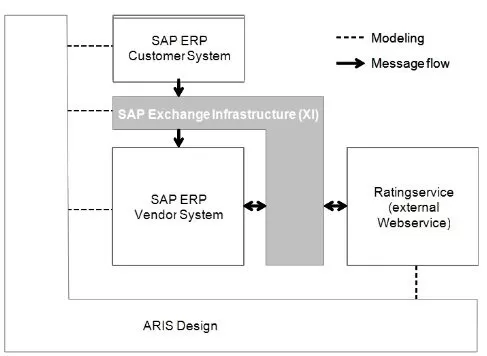
Fig 1. Systems used within the case study
Scenario The basic scenario (module 1) describes a company by using models that document the value added chain, flow of document and data (see table 1), and the financial impact (e.g. income statement or balance sheet). The focus is put on three processes: procurement, fulfillment, and production. It demonstrates how the various processes and functions utilize enterprise systems using a simulated SAP environment (Magal and Word 2009). This sets the context for a more specific fulfillment scenario developed in the following modules.
The main actors are two companies (vendor and customer). Since the two companies are assumed to have no pre-existing business relationship, the vendor checks the financial rating of the customer provided by an external agency. If the check ends with a positive result the order is processed. Otherwise, the order is rejected. Figure 1 depicts the systems necessary to run the scenario. Customer and vendor utilize two (hypothetically) independent SAP ERP systems (1). The agency performing the credit rating check is implemented as an external web service in Java and can be contacted synchronously via SOAP. The integration of the systems mentioned before happens via the SAP XI, which is part of the customer‘s system landscape. To model the entire process, the data structures as well as the processes in the vendor system, the ARIS Design Platform is used.
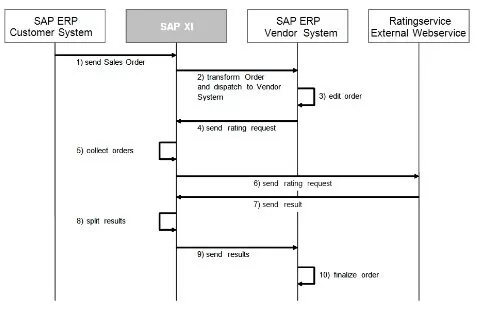
Figure 2 shows the entire process. The process is initiated by the customer by sending an order to SAP XI. The SAP XI now has to transform the simplified order in a format suitable for the SalesOrder-BAPI of the vendor system (2). This generates an order in the ERP system of the vendor. The resulting event („order received“) in the ERP system of the vendor triggers the further processing of the order by the vendor. In case of a new customer, the vendor system requests via the SAP XI information on the customer’s rating from the external rating service.
Fig 2. Sequential diagram of the inter-systems
It is supposed, that the costs of the external financial service can be reduced by collecting several information requests into one package and filing them together. The collection of the information requests is realized in step 5 via the Business Process Engine of SAP XI. The forwarding of the collected information requests in steps 6 and 7 is implemented in a synchronous fashion (3). The answer to the ERP system of the vendor is affected in an asynchronous fashion in step 9. The buyer can check the status of his order during the order process via an internet application.
Didactic Concept
Teaching Content
The case study is comprised of three modules. The first teaching module is devoted to provide general knowledge about inter-company business processes and enterprise systems, and how they can lead to a competitive advantage. The second teaching module is focused on the as-is-status in the context of ARIS models as well as the transformation into the to-be-status utilizing the Balanced Scorecard as well as the SAP Business Workflow. The third module is focused on the implementation of the enhanced to-be-status using SAP XI. While the first and second modules are mainly tailored to students of Business Informatics as well as Economics, the third module is tailored exclusively to students of Business Informatics.
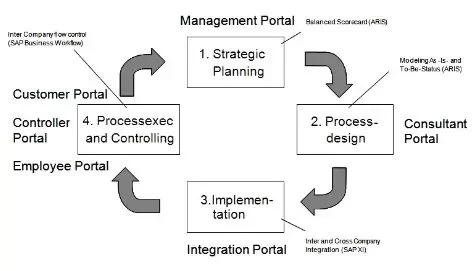
Fig 3. Process life cycle with supporting portal applications
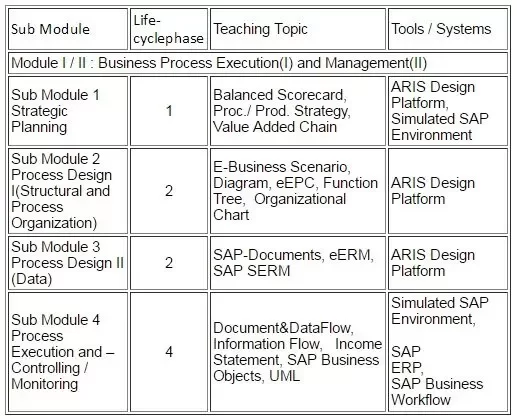
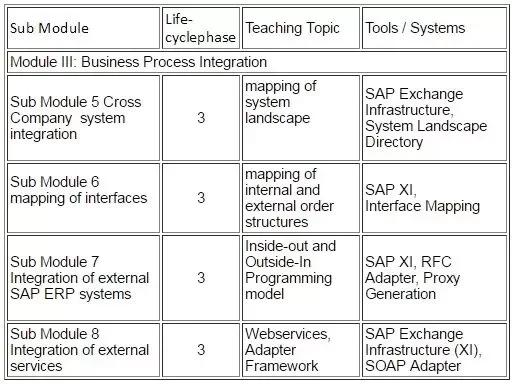
Fig. 3 describes four phases in business process management: planning, design, implementation, and execution. Module 1 and 2 encompass phases 1, 2 and 4. The implementation (phase 3) using SAP XI is discussed in module 3. Table 1 contains the four sub modules of the first and second module and their connection to the respective process life cycle phase. The table lists the concepts and tools that are taught.
Table 1: Teaching topics of the itemized sub-modules (Module 1 and 2)
Module 3 introduces students to the functions and components of SAP XI. The two different integration approaches offered by SAP XI (inside-out vs. outside-in) are explained (Nicolescu et al 2006). The interface between the customer system and the SAP XI follows the outside-in programming model. That is: an interface containing all relevant order data is defined in SAP XI, and then imported into the customer system (via proxy). This approach allows the quick and simple generation of a form for the collection of the order data in the customer system. The inside-out programming model is used to connect the customer system to the SAP XI. In this case the SalesOrder-BAPI from the vendor system is imported into SAP XI.
Within respect to the credit rating check, the primary focus is put on the inclusion of the external web service. The interface between the vendor system and the SAP XI regarding the credit rating check is modeled following the outside-in programming model and invoked as an encapsulated workflow function module during the credit rating check. The import of the web service in the SAP XI is accomplished using WSDL. The Business Process Engine of SAP XI is used to gather data from subsequent for logging purposes.
Table 2: Teaching topics of the itemized sub-modules (Module 3)
Learning targets
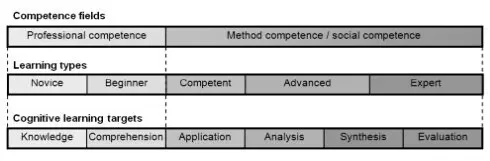
Based on the taxonomy of cognitive learning targets (Benjamin Bloom 1956), the following levels of complexity have been identified in the field of didactics: Knowledge, Understanding, Application, Analysis, Synthesis, and Evaluation. Aside from the teaching content, the definition of learning targets for a single teaching unit or an entire module can be seen as one of the most important tasks in designing a curriculum. Figure 4 exemplifies the interrelation between competence fields, learning types, and cognitive learning targets.
Fig 4. Competence fields, learning types and cognitive learning targets
The learning target of the first module is to give students formal and model-oriented introduction to business processes present in today’s companies, and to get in touch with SAP ERP. This sets the background for the next modules.
Within the second module, the learning target lies in understanding distributed processes and applying methods of abstraction to showcase entrepreneurial realities (Scheruhn 2009). The focus is on understanding how to model the As-Is- and To-Be-Status of processes applying modeling methods. By combining different model views, the participants can discover the integration processes within the company or departmental model and therefore learn about the interrelated structures in real companies. Sub-module 4 (see table 1) encompasses working with the To-Be-Status in the SAP Business Workflow via role-specific (customer or employee) online portals.
The learning targets of the third module are the understanding of the general integration demands as well as the application of different methods of integration.
Teaching methods
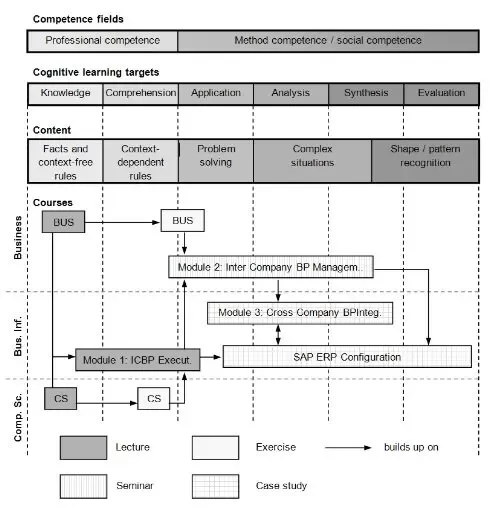
According to the scientific consensus, teaching topics, learning targets and teaching methods are the essential factors in education (Weidner 2003). While the lecture as standard teaching method is widely used in universities to satisfy the learning targets of gaining knowledge and promoting student understanding, a paradigm shift at universities has led to the application of learning methods that cover all competence fields and learning targets, e.g. Pegnetter et al (2006). Figure 5 shows how the three modules have been integrated into an already existing curriculum.
Fig 5. Graphical model of integrated curriculum
Teaching Forms and Materials
The teaching topics and learning targets made it necessary, to educate students in training sessions with obligatory attendance. The teaching module does not yet include defined eLearning units or standardized interfaces to learning management systems.
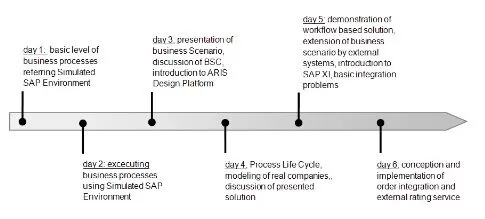
The teaching materials are designed to be used in block seminars. They include presentations to introduce the scenario and the main problem areas to students as well as a detailed description of what students have to do. Fig. 6 shows the setup for a typical seminar. The student workload is equal to the one of a regular lecture with 4 weekly hours.
Fig 6. Chronology of the teaching modules
Prerequisites The case study comes with certain demands towards students and lecturers as well as the technical infrastructure. The module is tailored for advanced students of Business Informatics or Economics. Aside from general knowledge about economic processes, an affinity towards technology is helpful for a successful participation. Furthermore, it is desirable that all participants have some prior experience with SAP systems. Skills in working with the ARIS Design Platform are not required.
To use the entire case study (especially module 2 and 3) effectively, a licensed version of a professional modeling tool is needed (ideally the ARIS Design Platform). Additionally, a SAP Backend System (with developer license) and a SAP XI System are needed. Since the basic configuration between SAP Backend System and SAP XI System is not part of the case study, it is strongly advised that both systems are maintained by a SAP UCC. In order to work with module 1 alone only a simulated SAP environment is necessary.
Teachers should be experienced in process modeling and system integration. Knowledge about the integration server SAP XI and the SAP Business Workflow are helpful.
Conclusion and Outlook
The case study gives students a chance to explore important methods of modeling in detail and to utilize and deepen knowledge gained in other lectures. Furthermore, important concepts of standard software integration are demonstrated via the direct implementation utilizing a modern implementation platform. While the base modules used (Sistemas de Informacion en la empresa I, Online Process Management and Integration of Information Systems with SAP XI) have been taught several times before, the combined modules described in this paper will first be used in classes in March 2010 at the University of Alicante (UA). It is planned to evaluate format and content of the case study at the involved universities (Glinz 2008).
In the next step it is also planned to translate all modules to English and Spanish and to offer it to foreign universities as part of current cooperations. While the current format is tailored to block seminars, future versions shall be suitable for weekly lectures as well as for home studies. Finally, we are currently working on a fourth module which will help students to implement business processes with SAP Business Workflow.
Endnotes
1 Basically, this scenario assumes two different logical systems. For simplification the case study uses two different users in one client instead. 2 During this process, the needed hierarchical data structure is derived from the flat data structure and afterwards processed by the BAPI.
3 An asynchronous forwarding would also be possible, but additional configuration steps (without any didactic value) would be needed.
References
Bloom, B. S. (1956), Taxonomy of Educational Objectives, Handbook I: The Cognitive Domain. New York: David McKay Co Inc.
Colomina, E. (2004), Empresas y Sistemas de Información: necesidad de Nuevos Marcos de Referencia. IV Encuentro Iberoamericano de Finanzas y Sistemas de Información. Sevilla.
Conrad, S., Hasselbring, W., Koschel, A. and Tritsch, R. (2006), Enterprise Application Integration, Grundlagen – Konzepte – Entwurfsmuster – Praxisbeispiele, Spektrum akademischer Verlag.
Döring, K.W. (1971), Lehr- und Lernmittelforschung, Döring, K.W.(ed), Beltz, Weinheim.
Glinz, M. (2008), ‘Modellierung in der Lehre an Hochschulen: Thesen und Erfahrungen‘, Informatik Spektrum, 31 (5), 425-434.
Klimsa, P. (1993), Neue Medien und Weiterbildung: Anwendung und Nutzung in Lernprozessen der Weiterbildung, Deutscher Studien Verlag, Weinheim.
Magal, S. and Word, J. (2009), Essentials of Business Process and Information Systems, Wiley.
Nicolescu, V., Funk, B., Heiler, M. and Niemeyer, P. (2006), Entwicklerbuch SAP Exchange Infrastructure, SAP Press.
Pegnetter, R., Rautenstrauch, C., Scheruhn, H., Schrader, H., Weidner, S. (2006), ‘Strategic orientation of a Master’s program with emphasis on integration competence demonstrated with mySAP‘, Proceedings of 7th GITMA, Orlando-Florida, 160-163.
Scheruhn, H. J. (2009): ‘Online Process Management mit SAP ERP‘, http://hscheruhn.hs-harz.de/lehre/alle/OPM-script-de.
Scheruhn, H.J.; Gomez, J.M.; Reiter, C. (2004): Online Process Management with mySAP, Conference transcript CICE 2004, Santa Clara.
Weidner, S. (2003), ‘Fallstudiendesign mit Hilfe der Case Study Methode am Beispiel der Integration von Unternehmensstrukturen in ein ERP-System‘, Diplomarbeit, Otto-von-Guericke-Universität Magdeburg.